

Why SiRah exists
Semiconductors shape every industry. Their ecosystem is complex.
Before a chip reaches a car, a factory or a data centre, it passes through many companies, countries and public programmes. Each step depends on another: no chip design without design software, no fab without equipment, no equipment without specialised materials, no AI system without advanced packaging. Each handover is a decision, and an opportunity.
Markets are moving.
New fabs, programmes and supply chains are reshaping where demand and partners are.
The buyer is rarely the decider.
Engineering, purchasing, management and public stakeholders all shape the outcome.
Windows open, and close.
Design-in windows and programme calls set their own timing.
Public money shapes the market.
Programmes, consortia and sovereignty goals need industry to lead.
The semiconductor ecosystem
Hover over any part to see what happens there
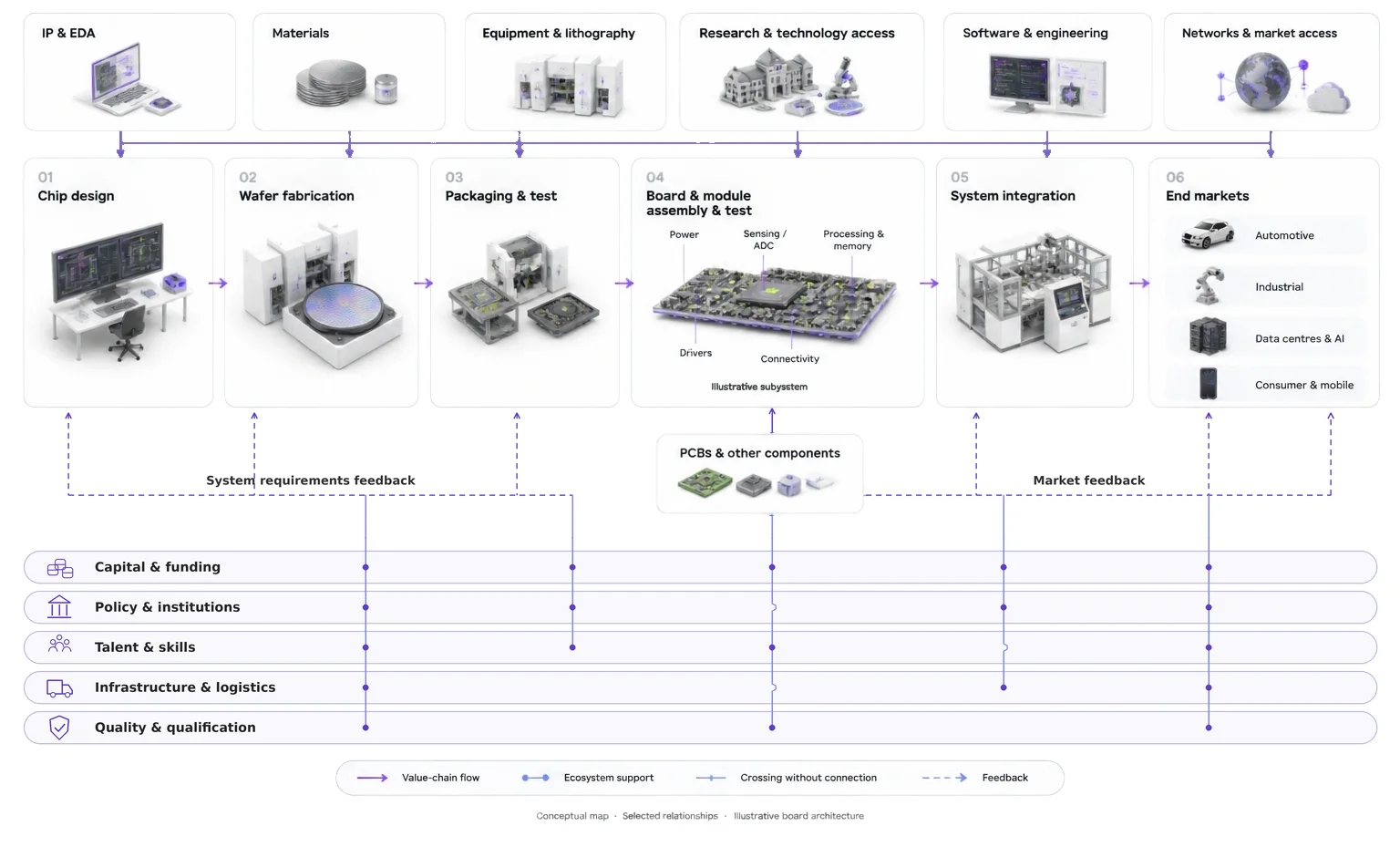
What happens where
IP & EDA
Design software and licensed circuit blocks that every chip designer relies on. A small number of suppliers serve the whole industry.
Materials
Silicon wafers, chemicals, gases and substrates. Highly specialised, and often sourced from a few suppliers in a few countries.
Equipment & lithography
The tools that build chips, from lithography to deposition, etching and inspection. No fab runs without them.
Research & technology access
Universities, research institutes and pilot lines, where new processes and technologies are developed and proven before industry adopts them.
Software & engineering
Embedded software, design services and engineering partners that turn a chip into a working solution for the customer.
Networks & market access
Distributors, clusters, alliances and application partners that connect technology with customers in each region.
01 Chip design
Engineers define the architecture and design the circuits. Many chip companies are fabless: they design, and partners manufacture.
02 Wafer fabrication
Circuits are built layer by layer on silicon wafers, through hundreds of process steps. The most capital-intensive step in the chain.
03 Packaging & test
Wafers are cut into individual chips, packaged and tested. Advanced packaging now shapes the performance of AI and high-performance chips.
04 Board & module assembly
Chips are mounted with other components on boards, often by EMS partners, to form modules for power, sensing, processing and connectivity.
05 System integration
Boards and modules become complete products: a vehicle control unit, a medical scanner, a server. Here the requirements are set that flow back to chip design.
06 End markets
Automotive, industrial, data centres and AI, consumer and mobile, medical and more. Demand here decides what the whole chain builds next.
PCBs & other components
Printed circuit boards, passive components and connectors that sit alongside the chips on every board.
Capital & funding
Venture capital, corporate investment and public funding programmes that finance fabs, startups and research.
Policy & institutions
Ministries, agencies and alliances that set strategy, incentives, export rules and programmes such as the Chips Acts.
Talent & skills
Engineers, technicians and operators at every step. Often the scarcest resource when new sites are built.
Infrastructure & logistics
Power, water, cleanrooms, transport and secure supply routes that every site depends on.
Quality & qualification
Standards, certification and customer qualification, especially in automotive and medical, which decide how fast a product reaches the market.
What we do · Connect · Unlock · Grow
We design the path from technology to business. Markets, partners, programmes, and the terms that make them work.
Also available on its own or within any service: Programme Fit & Consortium Readiness

Ecosystem signals
What is moving in the ecosystem.
Last updated 20 Oct 2026 · All signals →
Source: GlobalFoundries Sep 2026 Commercial production starts at a new packaging plant in Surat India · Sites
Source: ANI Sep 2026 Fab2 raises a $500m Series A for small-scale fabs United States · Startups
Source: Crunchbase News